Custom furniture
Pooja unit design
A niche, a standalone unit or an integrated panel — detailed around the family's practice and the home's material palette.
What matters here
How we approach pooja unit design
- Placement is discussed with you first — direction and position are your decision, not ours.
- Proportion is set against the wall it sits on, so the unit neither crowds nor disappears.
- Doors, drawers and a pull-out shelf keep daily items in reach and out of sight.
- Materials are chosen to take heat, oil and smoke near the lamp without staining.
A unit designed around how it is used daily
A pooja unit is used every morning, often in a hurry. That argues for practical detail: a pull-out shelf at working height, a drawer for wicks and matches, a small ventilated section above the lamp, and a surface that wipes clean. We ask how the space is used before drawing anything — who uses it, how often, and whether it needs to be closed off when guests are in the room.
Freestanding, wall-mounted or a dedicated corner
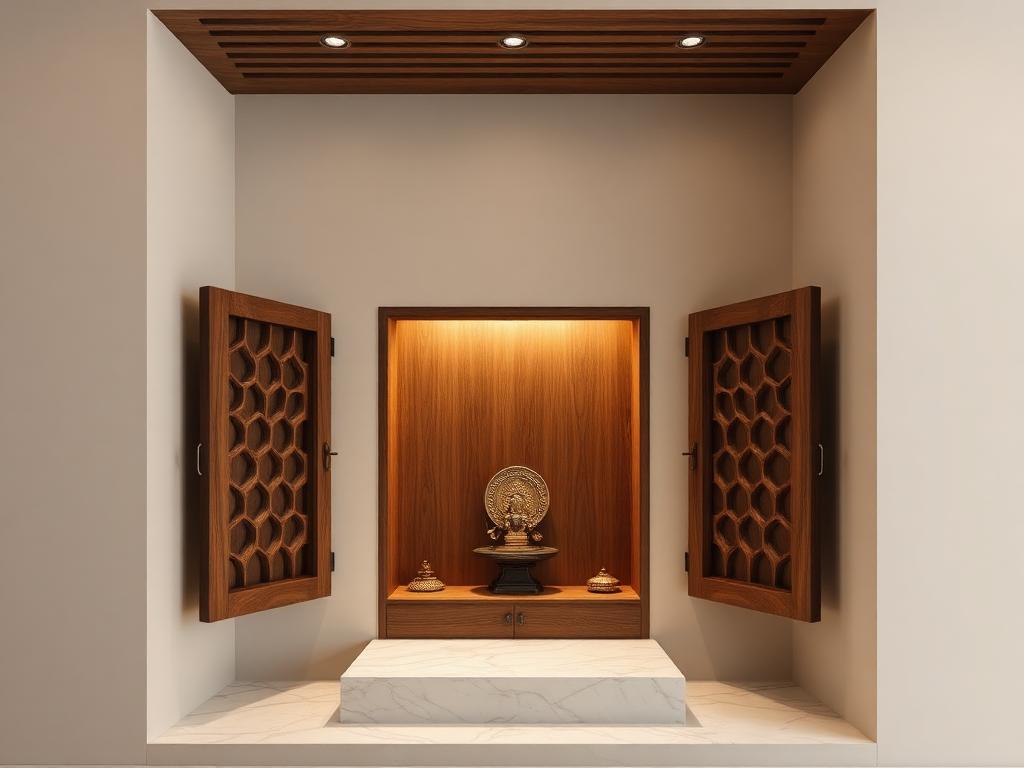
In compact apartments a wall-mounted unit with folding shutters keeps the floor clear and can be closed. In larger homes a dedicated alcove with a jaali screen, a raised platform and concealed lighting is possible. Both work; the constraint is usually wall length and the position of the nearest switch point.
Materials near an open flame
The surface directly above a lamp takes heat and soot. We specify a wipeable, heat-tolerant panel there rather than an open-pore veneer, keep the immediate zone ventilated, and avoid fabrics in the line of the flame. Brass or antique-finish hardware is a common request and holds up well against the warm tones usually chosen for these units.
FAQ
Pooja unit design — common questions
Let's begin
Let's design a home that works beautifully for the way you live
Tell us about your space and how you use it. The first consultation is free and carries no obligation.